CHOICE Arrangement (ICHRA)
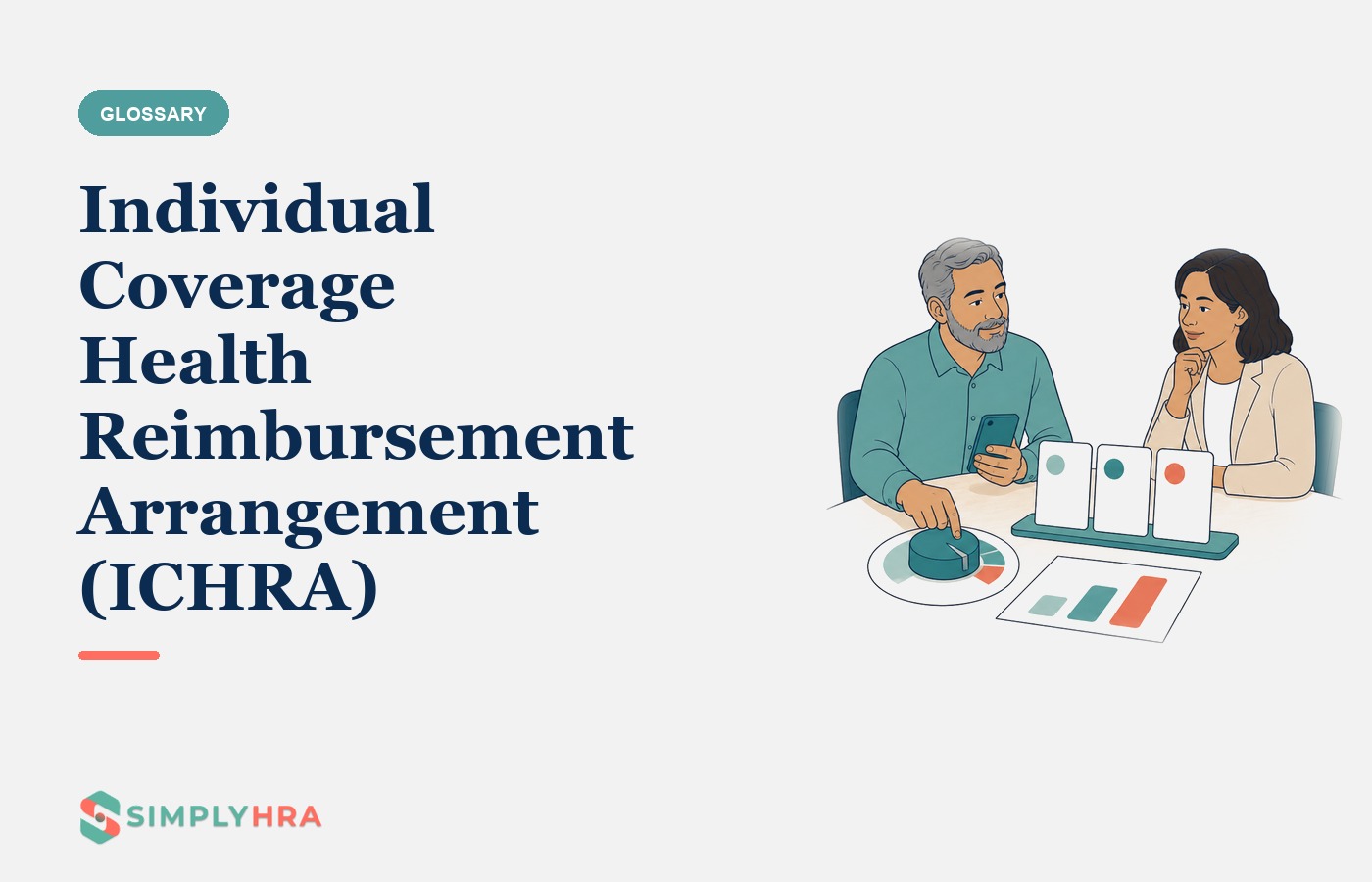
A note on terms: a CHOICE (Custom Health Option and Individual Care Expense) Arrangement, previously referred to as an ICHRA (Individual Coverage Health Reimbursement Arrangement), is the same benefit under its current name. The Centers for Medicare & Medicaid Services (CMS) now uses the CHOICE name, and this page uses both terms. For what the name change does and does not affect, see CHOICE Arrangement (formerly ICHRA).
As a small business owner, finding the right health benefits for your employees can feel like navigating a maze. You want to provide meaningful coverage without breaking the bank, but traditional group health plans often come with high costs and complex administration. That's where the Individual Coverage Health Reimbursement Arrangement (ICHRA) comes in. It’s a flexible, cost-effective solution that lets you reimburse employees for health insurance without the hassle of managing a group plan.
In this article, we’ll break down everything you need to know about ICHRA, from how it works to its benefits and requirements. Let’s simplify health benefits for your small business.
What is an Individual Coverage Health Reimbursement Arrangement (ICHRA)?
An Individual Coverage Health Reimbursement Arrangement (ICHRA) is a type of employer-funded benefit that allows businesses to reimburse employees for health insurance premiums and qualified medical expenses. Unlike traditional group health plans, ICHRA enables employees to select their own individual health insurance policy that suits their needs, and the employer reimburses them tax-free.
How Does ICHRA Work?
- Employer Sets a Budget: The employer decides how much to reimburse each employee class (e.g., full-time, part-time, seasonal) each month. There’s no minimum or maximum contribution limit.
- Employee Chooses a Plan: Employees purchase an individual health insurance plan that meets their needs. This can be from the Health Insurance Marketplace or a private insurer.
- Tax-Free Reimbursements: Employees submit proof of their premium payments and other qualified medical expenses. The employer then reimburses them on a tax-free basis.
This flexibility means employees can choose the coverage they want, while employers can control costs without managing a complicated group health plan.
Who Can Benefit from ICHRA?
Small Businesses Looking for Cost Control
One of the biggest advantages of ICHRA is the ability to set a budget without worrying about unpredictable premium hikes. You decide how much to contribute, making it a cost-effective option for small businesses.
Employers Seeking Flexible Benefits
ICHRA allows you to design custom reimbursement plans for different employee classes, such as full-time vs. part-time employees. This flexibility helps you provide competitive benefits that attract and retain talent.
Employees Wanting Personal Choice
Employees love ICHRA because it gives them the freedom to pick a health insurance plan that works best for their unique needs. They’re not stuck with a one-size-fits-all group policy.
Key Benefits of ICHRA
Cost Predictability for Employers
With ICHRA, you set a fixed budget for reimbursements, eliminating the risk of sudden premium increases. This makes financial planning easier and more predictable.
Tax Advantages
- For Employers: Contributions are tax-deductible.
- For Employees: Reimbursements are tax-free as long as they are used for qualifying medical expenses or insurance premiums.
Hassle-Free Compliance
At SimplyHRA, we handle all the paperwork and ensure your ICHRA plan stays compliant with IRS and ACA requirements, so you don’t have to worry about legal complications.
What Are the Requirements for ICHRA?
To offer an ICHRA, there are a few key requirements:
- Eligible Individual Coverage: Employees must have individual health insurance that meets minimum coverage standards under the Affordable Care Act (ACA).
- Class-Based Design: You must offer ICHRA to specific employee classes, such as full-time, part-time, or seasonal workers, to avoid discrimination.
- Employee Notification: Employees must be informed at least 90 days before the start of the plan year.
- Substantiation: Employees need to provide proof of their insurance coverage to receive tax-free reimbursements.
How Does ICHRA Compare to Other Health Benefits?
ICHRA vs. Group Health Insurance
- Cost: ICHRA allows employers to control costs with fixed reimbursement amounts, while group health premiums can fluctuate.
- Flexibility: ICHRA offers more flexibility as employees choose their own plans, unlike the one-size-fits-all group policies.
- Administration: ICHRA is simpler to administer, especially with SimplyHRA handling compliance and paperwork.
ICHRA vs. QSEHRA
- Employer Size: QSEHRA is only available for businesses with fewer than 50 employees, while ICHRA has no size restrictions.
- Contribution Limits: ICHRA has no contribution limits, whereas QSEHRA has annual maximums set by the IRS.
- Employee Classes: ICHRA allows more customization by employee class, while QSEHRA requires uniform benefits for all employees.
Is ICHRA Right for Your Small Business?
ICHRA is ideal for small businesses looking to:
- Control health benefits costs without the risk of premium hikes.
- Offer flexible, customizable benefits that attract and retain employees.
- Provide tax-advantaged health reimbursements without the burden of managing a group plan.
If you want to offer competitive health benefits while keeping things simple and affordable, ICHRA is a great choice.
Why Choose SimplyHRA for Your ICHRA Needs?
At SimplyHRA, we make setting up an ICHRA plan quick and easy. Here’s why small businesses choose us:
- Cost Control Without Surprises: You set your budget with no unexpected premium increases.
- Employee Freedom: Employees pick the health plan that works best for them.
- Hassle-Free Compliance: We handle the paperwork, keeping you compliant with all IRS and ACA regulations.
- Affordable and Efficient: Our software does the heavy lifting, saving you time and money.
We believe in making health benefits simple, flexible, and affordable for small businesses. Want to learn more? Schedule a demo or Sign up for an employer account today.
Final Thoughts on ICHRA for Small Businesses
ICHRA offers small businesses the flexibility and cost control they need to provide competitive health benefits. By giving employees the freedom to choose their own insurance plans, ICHRA keeps them happy while you stay on budget. With SimplyHRA, setting up an ICHRA is hassle-free, fully compliant, and tailored to your unique business needs.
Ready to take the next step? Contact SimplyHRA to learn more about our flexible ICHRA plans and how they can benefit your small business.
When Coverage Starts: Timing and Enrollment Windows
An employer can start a CHOICE (ICHRA) on almost any date, but individual health insurance usually starts on the first day of a month. That mismatch is the timing detail that catches most employers out.
Offering the arrangement for the first time opens a Special Enrollment Period, generally 60 days, so employees can buy individual coverage outside Open Enrollment.
If the plan year starts mid-month, reimbursements are typically prorated until coverage begins.
Marketplace enrollment follows federal rules and deadlines, not the employer's calendar.
New hires and waiting periods
Employers may apply a waiting period, commonly up to 90 days, before new hires become eligible, as long as the same rule applies to everyone in the class. During that gap an employee may rely on COBRA, a spouse's plan, or their own Marketplace coverage.
What Can Be Reimbursed Beyond Premiums
Premiums are the most common expense, but an employer can also choose to reimburse other medical expenses defined under Section 213(d) of the tax code, such as:
Doctor and specialist visits
Prescription medications
Mental health care
Diagnostic tests and imaging
The employer decides at plan design whether the arrangement covers premiums only, or premiums plus medical expenses.
Every reimbursement needs substantiation
Employees must show proof of the expense, such as a receipt or insurer statement showing the date, amount, and nature of the expense, and proof that they are enrolled in qualifying coverage. Substantiation is what keeps reimbursements tax-free, so it is not optional paperwork.
How It Affects Payroll and Taxes
For the employer
Reimbursements are generally deductible as a business expense, and properly administered reimbursements are not subject to employer payroll taxes. There is no requirement to pre-fund accounts, so money only leaves the business when an employee actually claims.
For the employee
When the rules are followed, reimbursements are excluded from gross income, which means no federal income tax, Social Security tax, or Medicare tax on those dollars. If an employee stops maintaining qualifying individual coverage, reimbursements must stop, and amounts paid without qualifying coverage become taxable.
Can Business Owners Participate?
Owner eligibility depends on how the business is taxed, not on the platform:
C-corporation owners who are W-2 employees can generally participate.
S-corporation owners with more than 2% ownership generally cannot.
Sole proprietors and partners are generally not eligible as employees.
These rules come from IRS guidance, so confirm your own situation with a tax advisor before rollout.
Covering spouses and dependents
Employers can extend reimbursements to employees' spouses and children if the plan document allows it. Family members need qualifying individual coverage too. This matters most for employees whose family premiums are far higher than self-only coverage.
How It Interacts With Marketplace Subsidies
This causes more confusion than any other part of the benefit. If an employee is offered a CHOICE (ICHRA):
If the offer counts as affordable, the employee cannot also receive premium tax credits, even if they turn the offer down.
If the offer is not affordable, the employee can decline it and pursue premium tax credits instead.
An employee who accepts the arrangement cannot claim premium tax credits for those months.
Affordability uses a federal formula that compares what the employee would pay after the allowance against an IRS percentage that is updated each year. It is a calculation, not a judgment call.
What Happens When an Employee Leaves
A CHOICE (ICHRA) is a group health plan, so federal COBRA can apply when the employer and plan are covered by it. If leaving causes a loss of the benefit, qualified beneficiaries may have the right to continue it, generally at their own expense. The individual insurance policy itself belongs to the employee and can continue as long as they keep paying the premiums.
State Differences Worth Knowing
The arrangement is federal, but insurance is regulated state by state. The structure does not change, but individual markets do: some states have many carriers and broad networks, others far fewer, which affects premiums and employee satisfaction. States such as California, New York, and Massachusetts run their own Marketplaces with their own deadlines and plan designs. Employers do not need to master this, but whoever supports employees should know it.
Common Mistakes to Avoid
Offering the benefit without issuing the required employee notice
Reimbursing expenses before verifying that the employee has qualifying coverage
Offering a group health plan and a CHOICE (ICHRA) to the same class of employees
Changing allowances retroactively instead of at the start of a plan year
Running substantiation through email and spreadsheets instead of a system
Three Misconceptions Worth Clearing Up
"It is just a stipend"
No. A stipend is taxable cash with no compliance structure. This is a formal benefit governed by federal rules, which is exactly why reimbursements can be tax-free.
"Only very small companies can use it"
No. There is no size limit. Employers of any size can offer it, including those with hundreds of employees.
"Employees can buy any plan at all"
No. Employees need qualifying individual coverage that meets Minimum Essential Coverage. Short-term, fixed indemnity, and similar limited plans do not qualify.
Frequently Asked Questions (FAQs) about Individual Coverage Health Reimbursement Arrangement (ICHRA):
Q: Can ICHRA be used to reimburse employees for out-of-pocket medical expenses?
A: Yes, ICHRA can reimburse employees for qualifying out-of-pocket medical expenses, such as copays, deductibles, and prescriptions, in addition to individual health insurance premiums. The employer determines which expenses are eligible for reimbursement when designing the plan.
Q: Can an employer offer both ICHRA and a traditional group health plan?
A: Yes, but not for the same class of employees. For example, full-time employees could be offered a group health plan while part-time employees are offered a CHOICE (ICHRA). Minimum class size rules can apply when both are offered.
Q: What happens if an employee does not use the full ICHRA reimbursement amount?
A: If an employee does not use the full amount allocated for ICHRA reimbursements, the unused funds remain with the employer. Unlike Health Savings Accounts (HSAs), ICHRA funds do not roll over to the next year for the employee.
Q: Can employees participate in an HSA if they receive ICHRA reimbursements?
A: Yes, in some cases. The employee must otherwise be HSA-eligible, including having qualifying coverage and no disqualifying other coverage. A premiums-only ICHRA generally does not disqualify an otherwise eligible employee. A general-purpose ICHRA that reimburses medical expenses before the applicable deductible is met generally prevents HSA contributions, while a properly designed limited-purpose or post-deductible ICHRA may preserve HSA eligibility.
Q: Are there any restrictions on the type of health insurance employees can purchase with ICHRA?
A: Yes, employees must purchase a plan that meets the minimum essential coverage requirements under the Affordable Care Act (ACA). This includes individual health plans from the Health Insurance Marketplace or a private insurer, but not short-term or limited-duration insurance plans.
Q: How does ICHRA affect employees who qualify for premium tax credits on the Health Insurance Marketplace?
A: If an employee is offered an ICHRA that makes their health insurance “affordable” according to ACA guidelines, they are not eligible for premium tax credits on the Health Insurance Marketplace. If the ICHRA is deemed unaffordable, the employee can opt out and claim premium tax credits.
Q: Can employees use ICHRA funds to pay for family health insurance premiums?
A: Yes, employees can use ICHRA funds to pay for family health insurance premiums, as long as the employer’s plan design allows it. The family members must also be covered by a qualifying individual health insurance plan.
Q: Is there a minimum or maximum amount an employer must contribute to an ICHRA?
A: No, there are no federal minimum or maximum contribution limits for ICHRA. Employers have complete flexibility to set reimbursement amounts that fit their budget and benefits strategy.
Q: Can an employer change ICHRA contribution amounts mid-year?
A: Allowances are set for the plan year, so changes are generally made at the start of a new plan year and applied consistently within an employee class. Changes are never made retroactively, and employees should be told well in advance, since most budget their premiums around the original allowance.
Q: How does an employee submit claims for ICHRA reimbursements?
A: Employees submit claims by providing proof of payment for eligible expenses, such as receipts or explanation of benefits (EOB) documents. Employers can simplify this process by using a third-party administrator or benefits management platform, like SimplyHRA, to handle claim verification and reimbursements.
Q: Can an employer offer a CHOICE (ICHRA) alongside dental, vision, or life insurance?
A: Yes. The restriction applies to major medical coverage. Stand-alone dental and vision plans, life insurance, disability cover, and wellness benefits can sit alongside it.
Q: What happens to the benefit when an employee leaves?
A: A CHOICE (ICHRA) is a group health plan, so federal COBRA can apply where the employer and plan are covered by it, generally at the former employee's own expense. The individual insurance policy belongs to the employee and can continue as long as they keep paying the premiums.
Q: Is CHOICE the same thing as ICHRA?
A: Yes. CHOICE is the current name for the arrangement previously called an ICHRA. See our CHOICE Arrangement glossary entry for what the name change does and does not affect.
Related glossaries

Dental Insurance
Direct Enrollment / Enhanced Direct Enrollment (EDE)