How to Use AI to Pick Your Health Plan
Let's face it, most people have a negative view of the current U.S. healthcare system.
Expensive, overwhelming, unreliable, ever-evolving — these are just some of the words that policyholders use.
What's 100% true, however, is that healthcare is ever-evolving.
It's not just due to changing regulations or the never-ending health insurance price hike. With emerging tech like Artificial Intelligence (AI), the plan selection process for consumers is also fast-transforming.
In this post, we'll discuss how to use AI to demystify the complex health insurance landscape for families.
Let's dive in.
Preparing Your Health Profile
AI tools are only as effective as the quality of data you provide.
You need to get your health profile in order — ready to paste into your AI tool of choice.
Just remember to keep it anonymized by withholding sensitive personal information, like names, birthdays, and exact addresses. The only details you should disclose must be necessary for health plan selection, like:
- Number of dependents — Are you seeking coverage for an individual or a household?
- Location — In which state, city, or county do you live and work?
- Ages of dependents — What are the ages and genders of everyone who'll be on the plan?
- Health snapshot — Do any of the applying members have any pre-existing medical conditions?
- Must-have medications or services — Which (generic) drug names and health services do you and/or your dependents need?
- Budget — How much are you willing to spend on a monthly basis for healthcare?
- Additional information — What other details or considerations should be factored in when choosing your health plan (HSA/FSA eligibility, travel frequency, subsidies, etc.)?
Preparing these details is an essential prerequisite if you need AI-generated insights tailored to your specific needs. That also means you should pick an AI tool that can retain information and keep sessions in context.
Some of the tools you can use to pick health plans are:
For the sake of this guide, we'll use ChatGPT for most of the steps. Just remember that modern benefits platforms like SimplyHRA also come with built-in AI tools that can be used as alternatives.
It's also highly recommended that you create an account to enable the tool to "remember" your conversation. This allows you to revisit the thread at any time as you go through your research.
How to Use AI to Choose a Health Plan
First things first, you need to enter your health profile details into ChatGPT.
1. Enter Your Health Profile
Start with a prompt like "I need to pick a health plan, but first I need you to remember my health profile," and paste the information you gathered earlier.
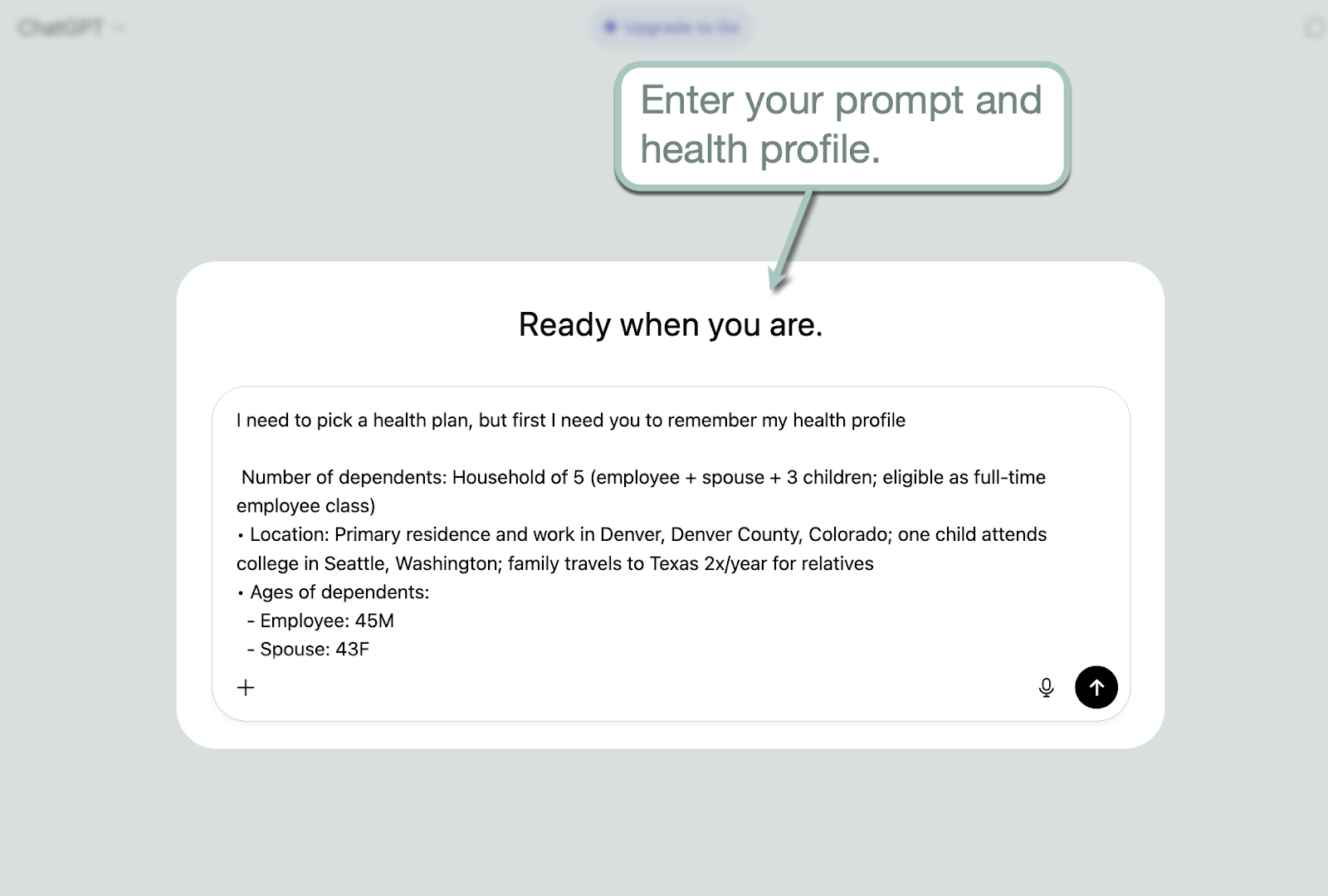
ChatGPT should verify that the information is saved. It will also provide additional tips and prompt recommendations that will drive your research forward.
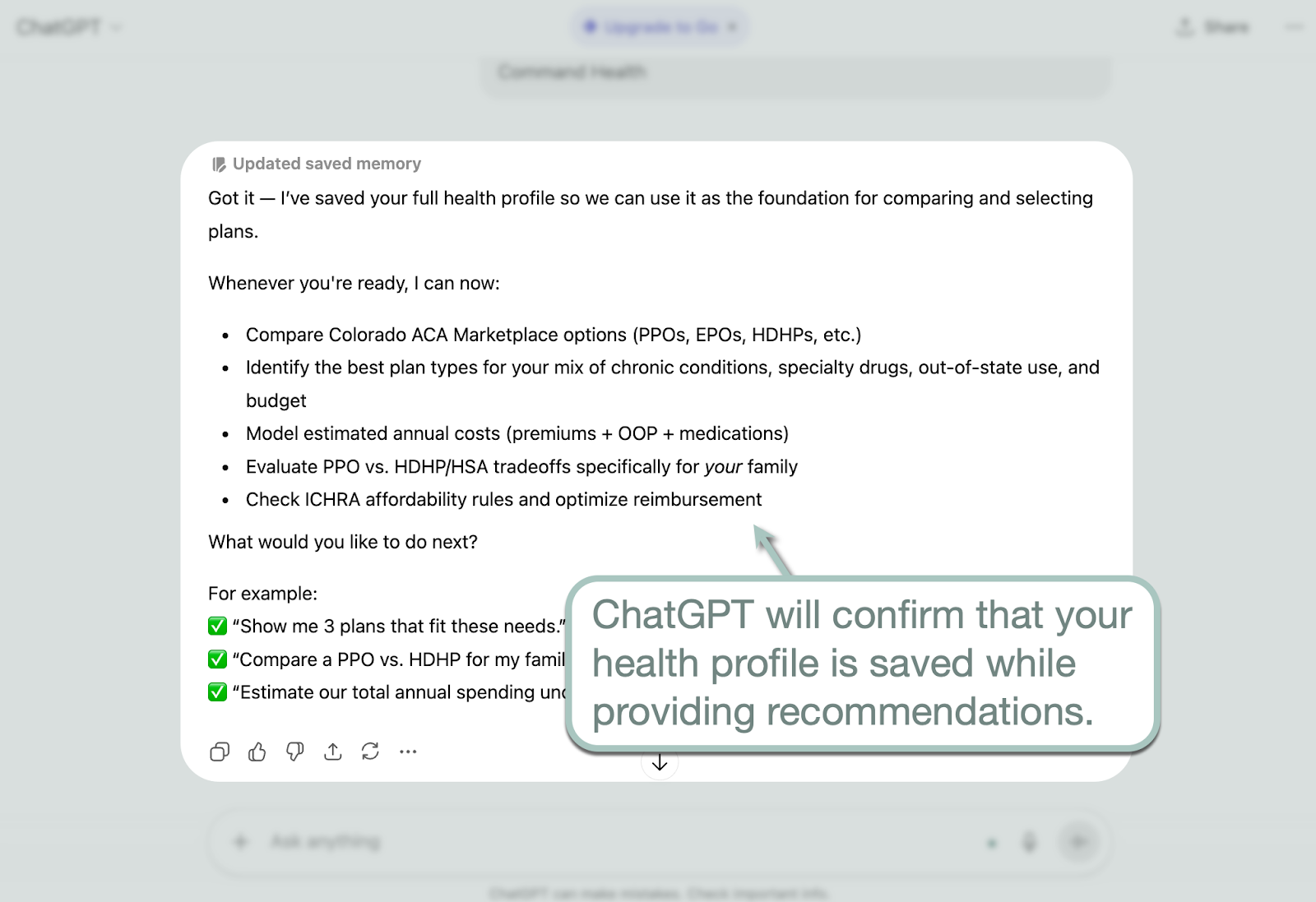
At that point, we can stop the guide here if ChatGPT's initial response already contains plan suggestions that catch your attention. Otherwise, let's move on to the next step:
2. Scan and Simplify Summary of Benefits and Coverage (SBC)
Reading, analyzing, and comparing SBCs is one of the most tedious aspects of choosing a health plan.
A regular SBC contains several pages dense with text — providing answers to common research questions surrounding the plan's deductibles, and provisions for different medical expenses.
With an AI tool, you can turn hours of nose-deep research into minutes.
Simply upload or paste the SBC's contents and let AI convert them using a more readable format. You can also instruct the AI to highlight important details like telehealth, authorization requirements, prescription tiers, referral rules, and so on.
Tip: ChatGPT has an attach feature that lets you upload a PDF copy of the SBC directly.
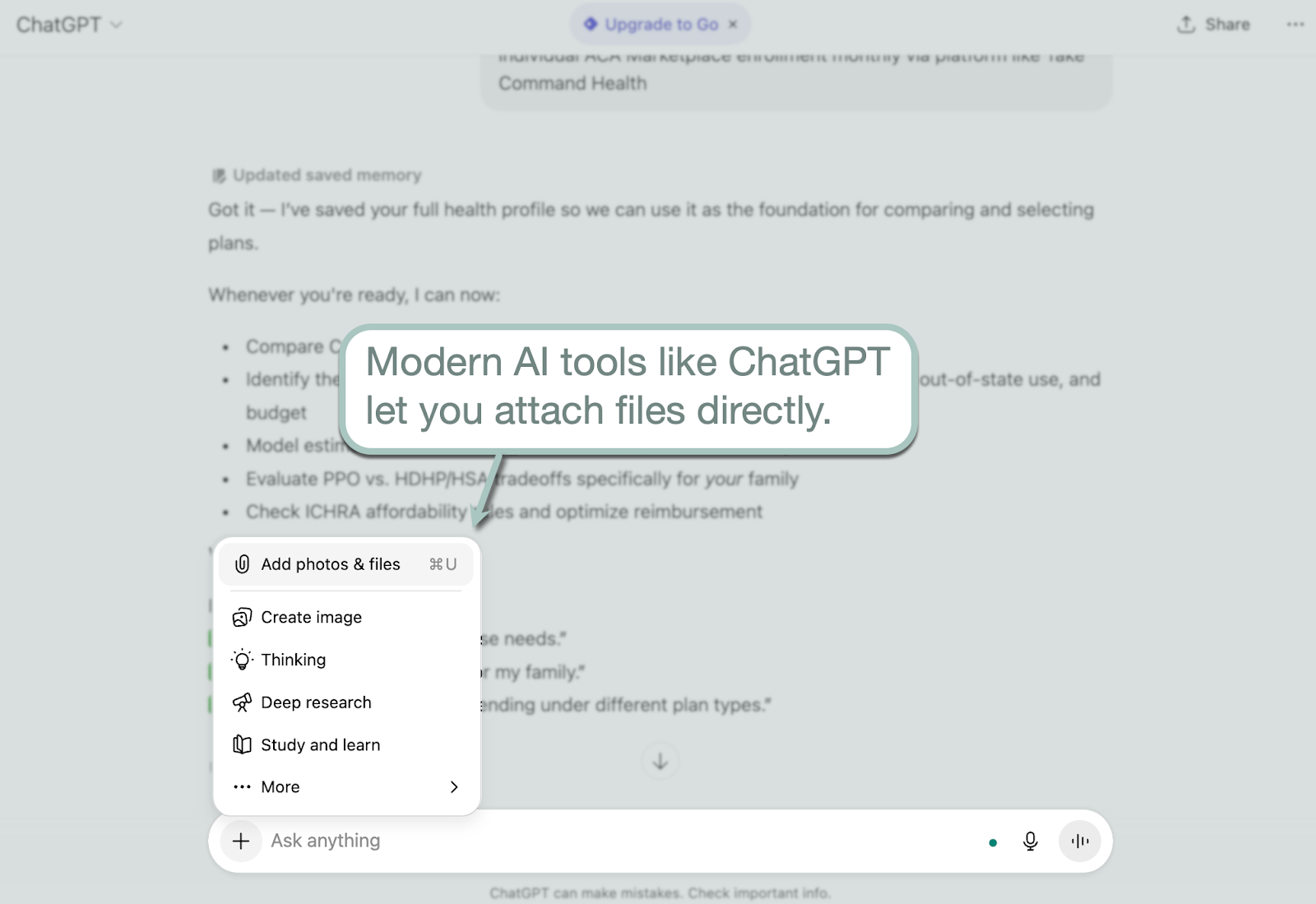
Just preface it with a prompt like "Create a clean and organized table with columns for out-of-pocket maximums, Rx tiers, PCP costs, copays, and telehealth costs."
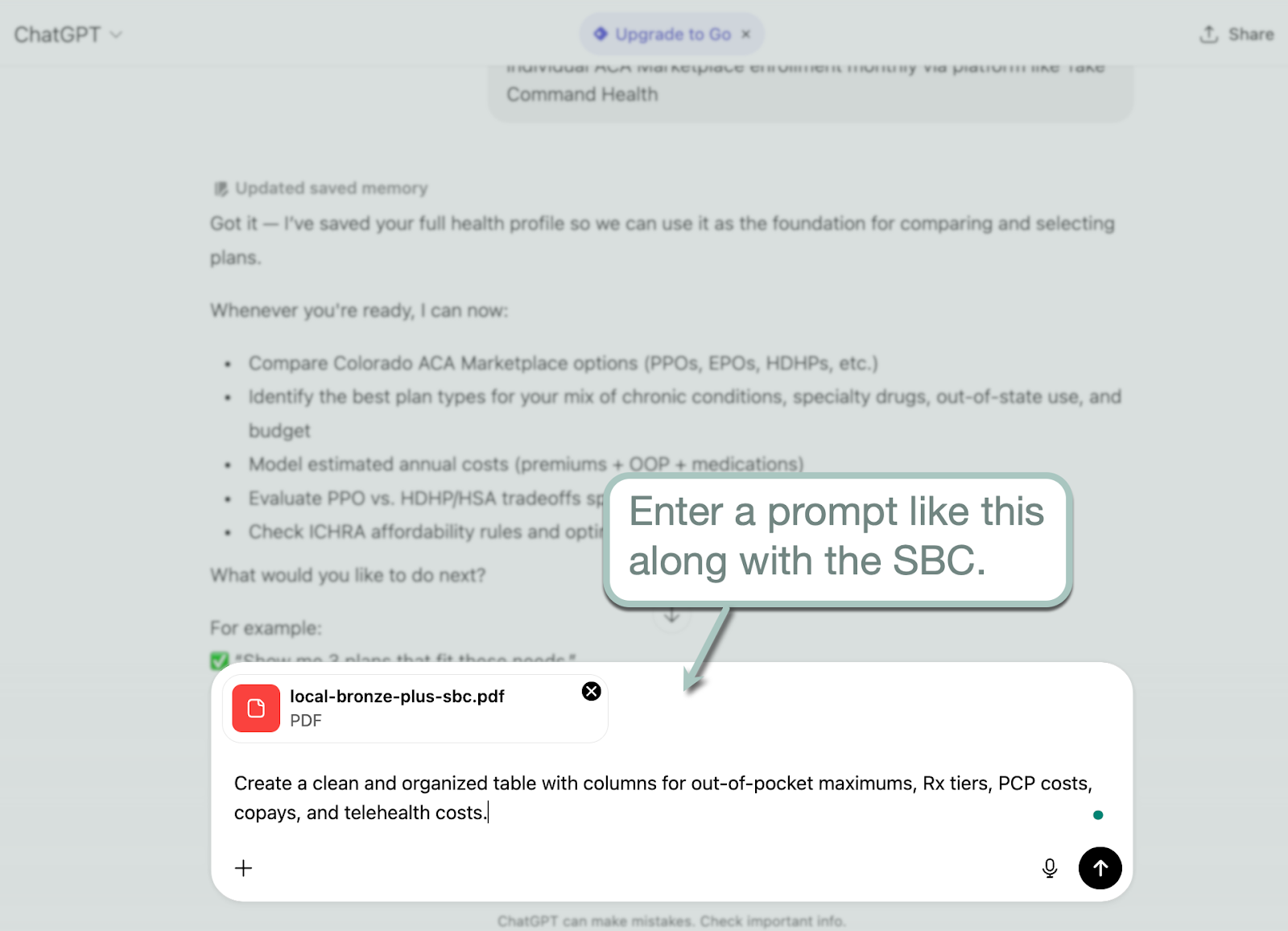
Within seconds, your pages and pages of SBC will be condensed into a more readable table with all the key information highlighted:
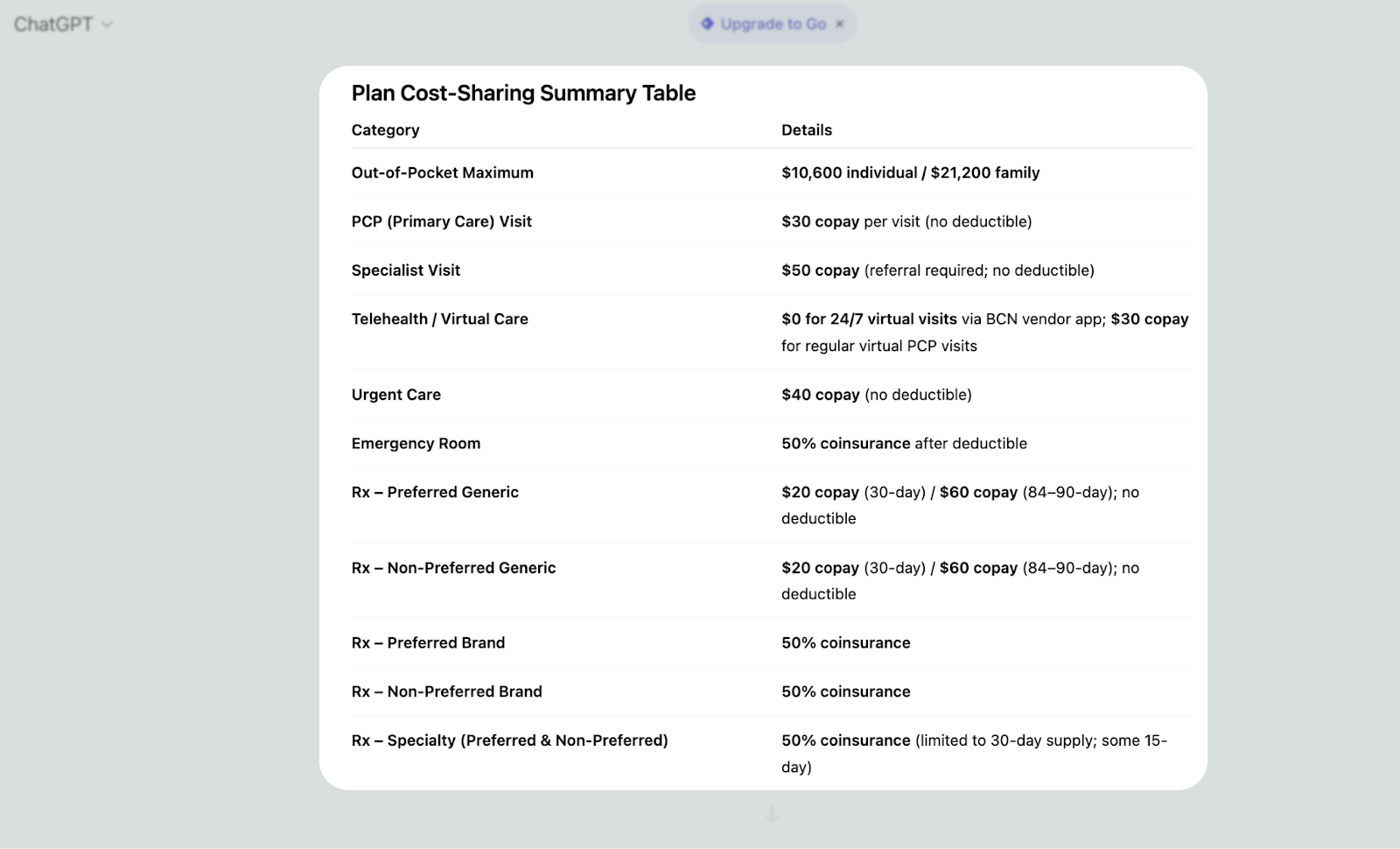
This method allows you to cut to the chase and reveal the details that matter in a health plan's SBC — potentially saving several hours if you're looking at multiple plans.
This brings us to the next step…
3. Compare SBCs Between Different Health Plans
Remember that some AI tools let you upload multiple files with a paid subscription, which means you can include multiple SBCs in one prompt.
Regardless, you can add more SBCs to the mix either via attachment or copy-paste. This enables you to conduct a quick side-by-side comparison of multiple health plans using the criteria you specified for your table.
For this, you'll need a prompt like "Here's another SBC, I need you to scan it and add the information to the table."
Feel free to modify the prompt depending on factors like how many SBCs you'll submit or the number of plans mentioned in each SBC. Remember, modern language models are more than smart enough to understand complex — even colloquial — prompts.
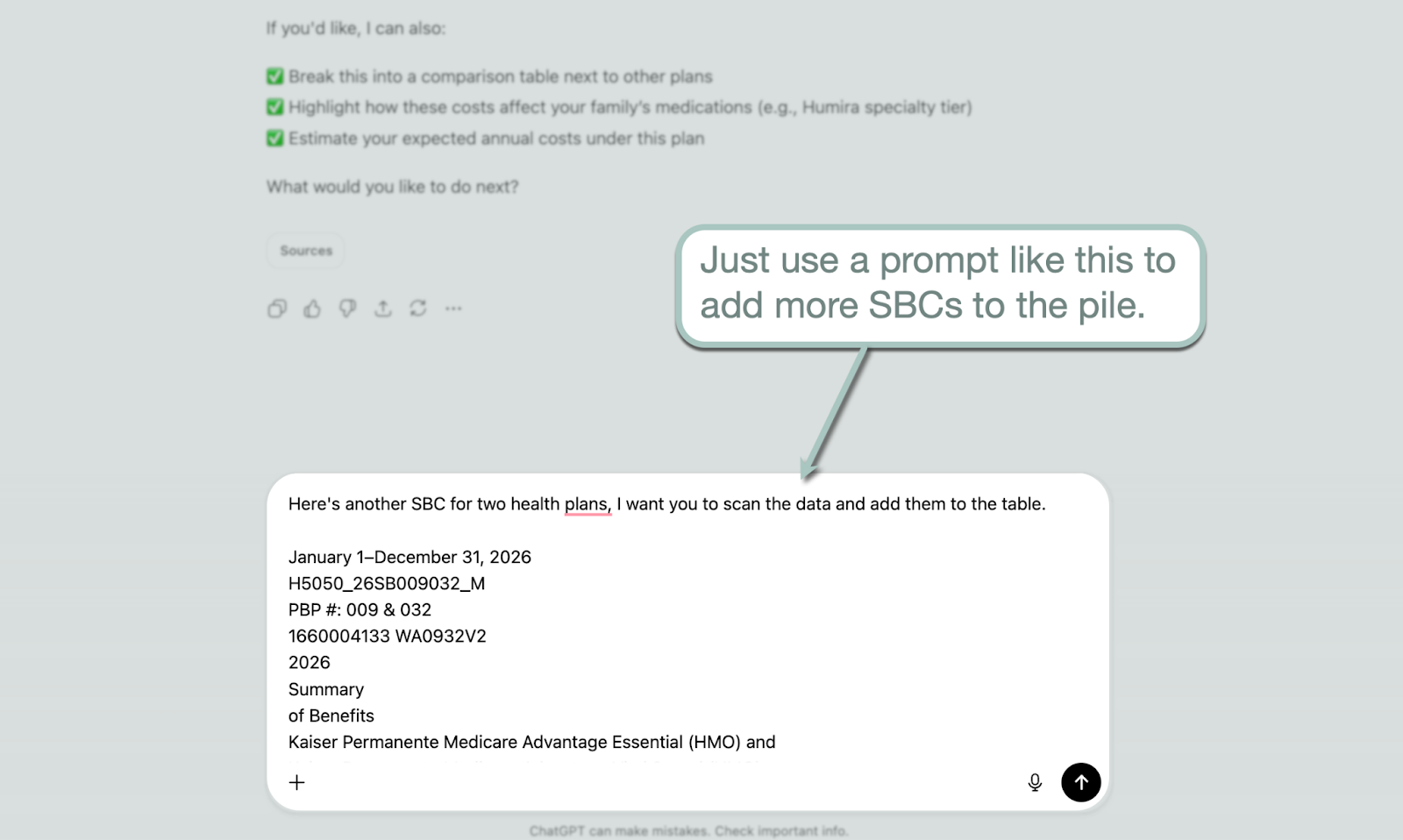
Like always, it should only take a couple of seconds for AI to organize all the information for you.
Imagine the time you'll save combing through several SBCs if you have a simple table like this:
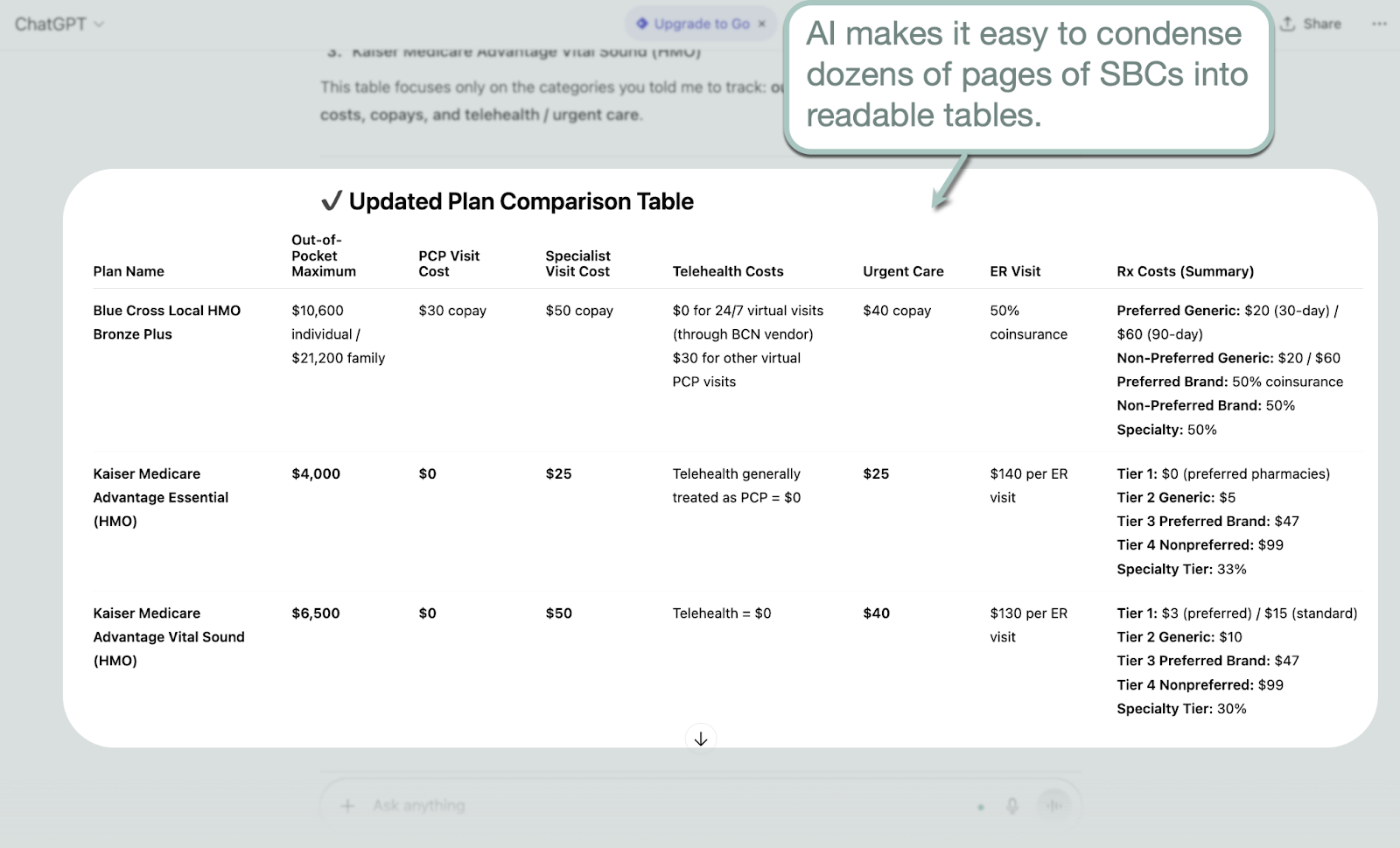
With this, it should be substantially easier to pick a health plan that perfectly matches your needs. You have AI to thank for cutting through the noise and surfacing useful tidbits of information that can actually help with your decision-making.
Why not take it a step further?
4. Ask AI to Make Estimates
Now that the data has been fed to the AI, it should be able to provide you with cost projections.
For this, you need to think about a few scenarios.
For example, you can ask, "What would a low-use year look like with the Blue Cross Local HMO Bronze Plus plan?"
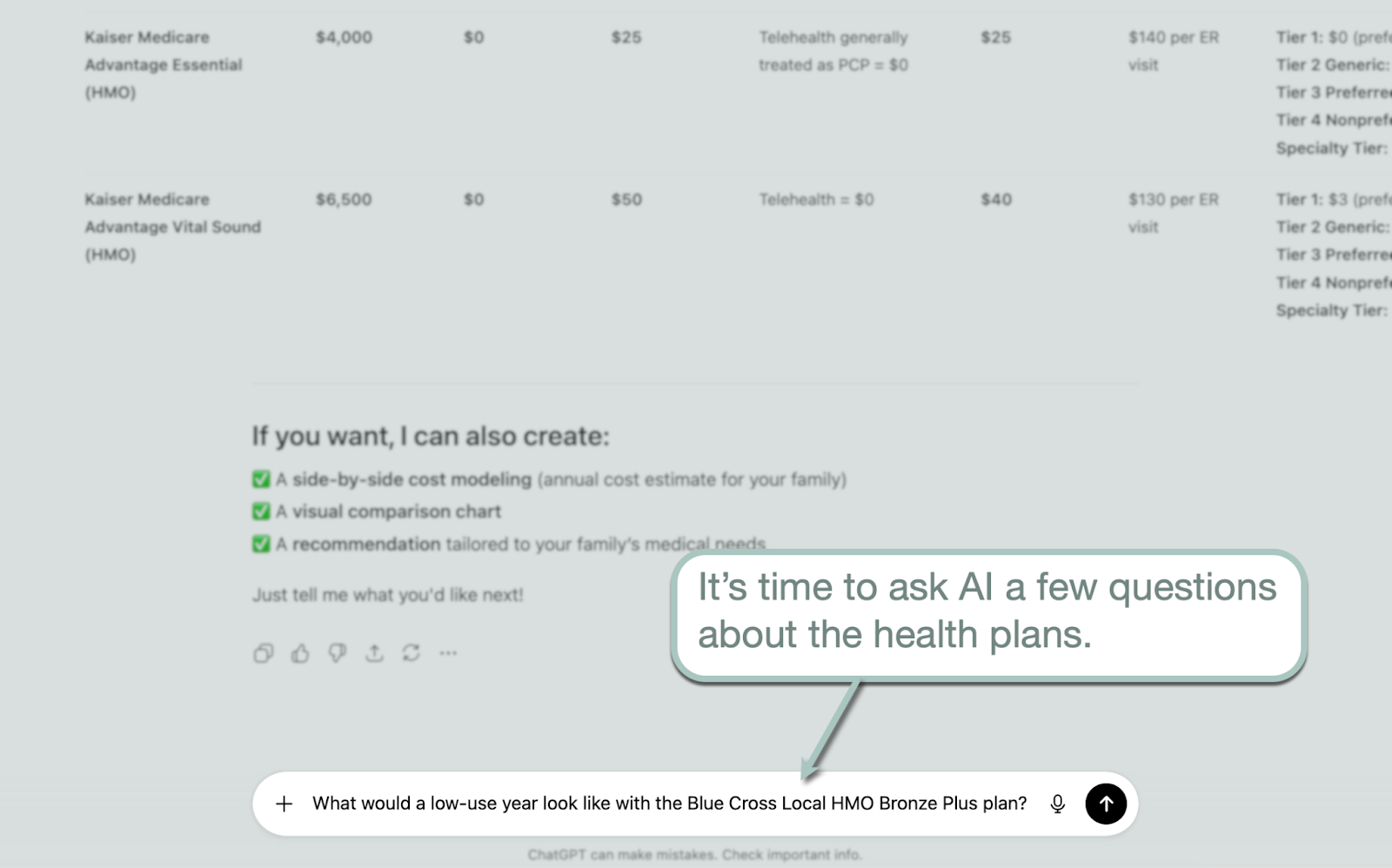
In seconds, you'll not only have your answer — you'll get a detailed breakdown of where your annual payments go.
In most cases, you also get explanations and suggestions on what to do next. But the best part is, ChatGPT (as well as other advanced generative AI tools) will tailor its response to the health profile and other prompts you communicated throughout the session.
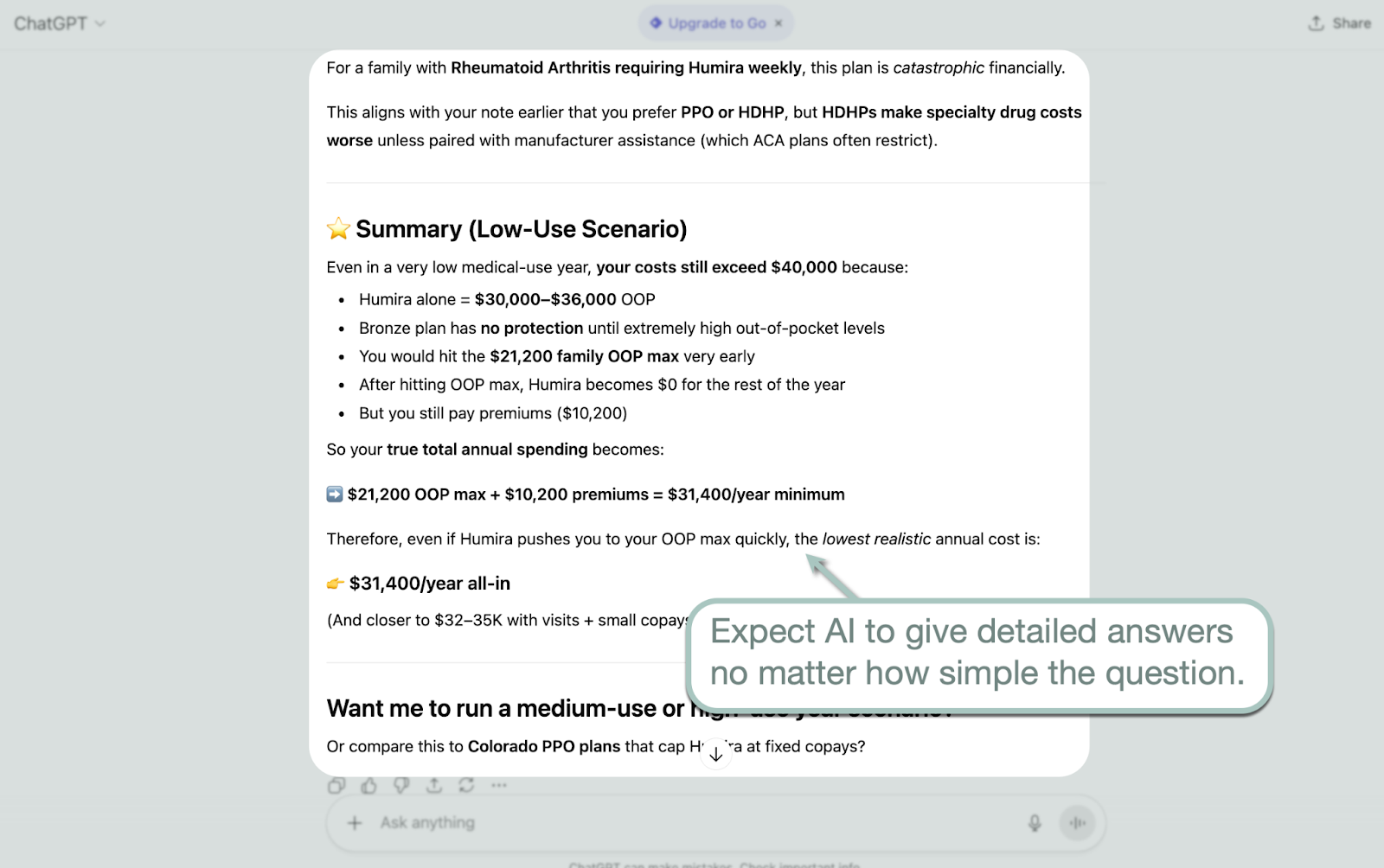
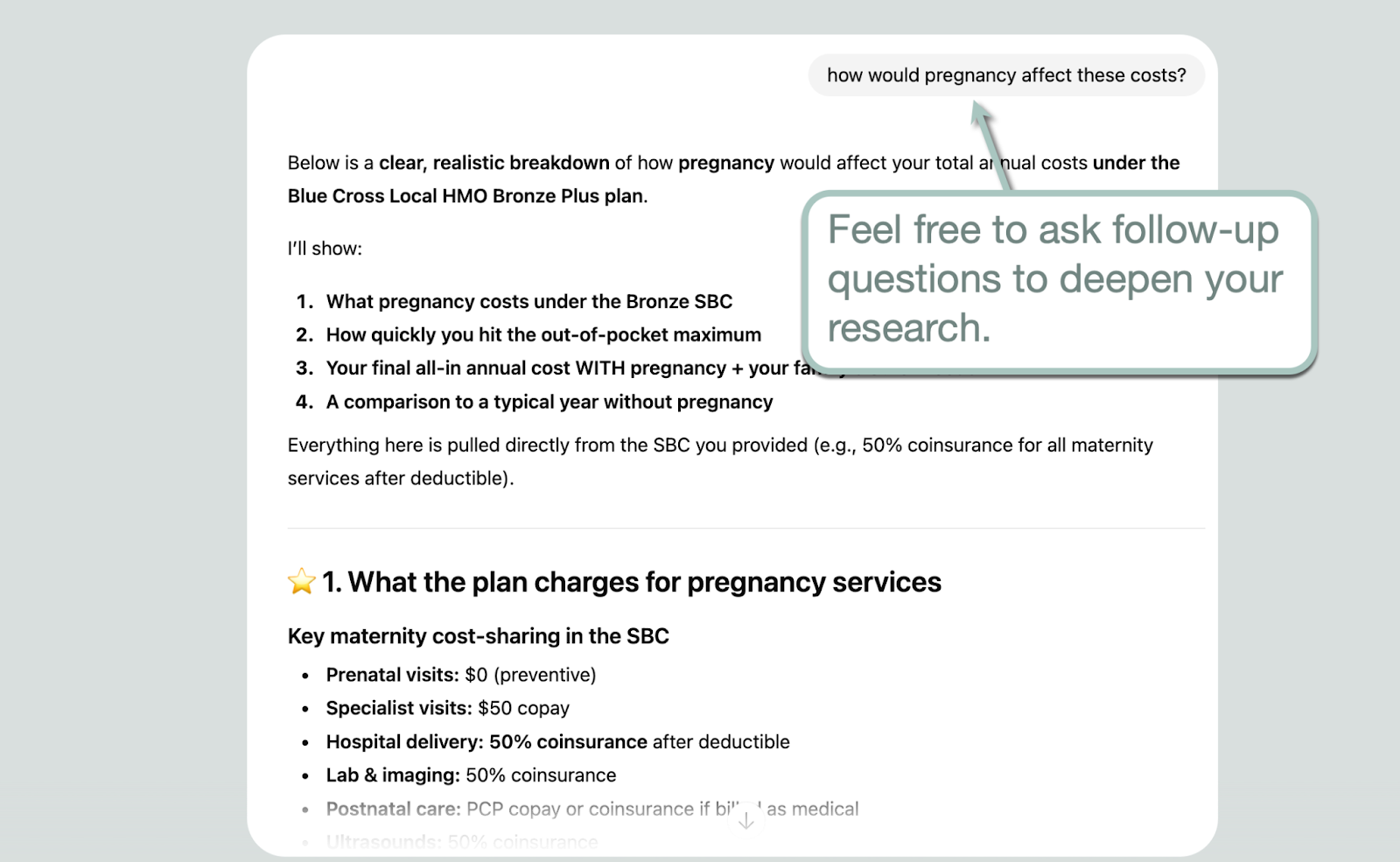
You can then go deeper by generating estimates for mid-use and high-use years. Or, come up with more specific scenarios based on different health snapshots (i.e., pregnancy).
Just ask your question directly, and ChatGPT will automatically factor in the context it gathered through your conversation, ensuring you get personalized insights.
5. Compare Plans with AI
Modern AI is advanced enough to go well beyond cost projections.
Consider asking AI which among the uploaded SBCs is the most cost-effective given your health profile.
Try a prompt like "based on your analysis, what plan is the best choice for me?"
ChatGPT will then provide a comprehensive analysis of the SBCs you uploaded, line everything up with your health profile, and pick a plan that results in the highest savings without compromising effectiveness.
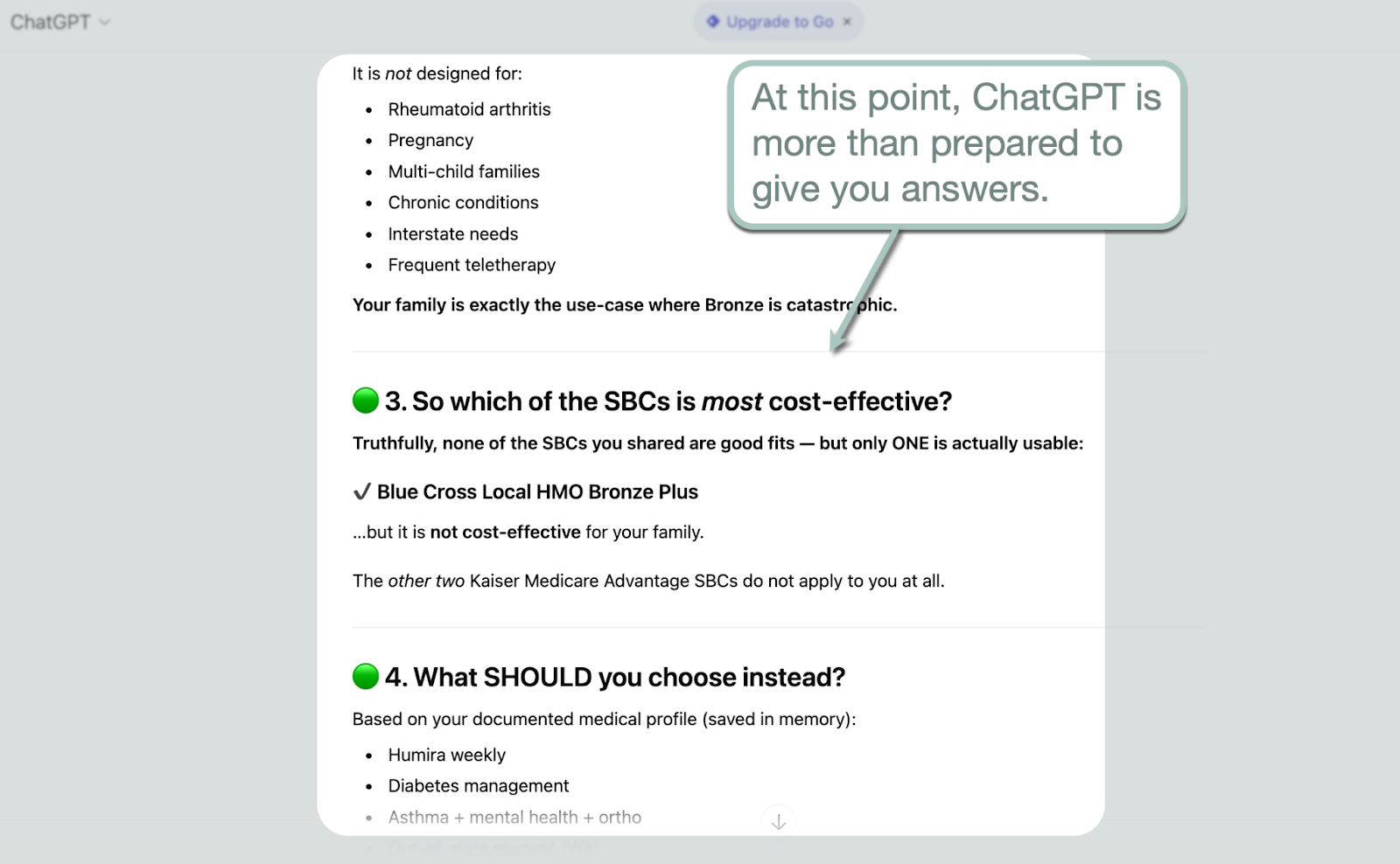
In some cases, ChatGPT will even suggest plans you didn't mention in the conversation. Just be sure to do your due diligence and look at those plans yourself or feed their SBC into the AI.
Don't forget about other variables that could greatly influence healthcare costs.
Here are a few more sample prompts that make sure you leave no stone unturned:
- "How does being a remote employee affect the costs and effectiveness of these plans?"
- "What are the events that would make [Plan #1] more expensive than [Plan #2]?
- "Which plans use fixed copays rather than coinsurance?"
- "Which plan is the best in terms of predictability and risk?"
- "What plans can provide in-network coverage if I relocate to [Location]?"
Remember, ChatGPT isn't the only AI tool capable of assisting you throughout the plan selection process.
SimplyHRA, for one, comes packaged with an in-app AI assistant you can use for plan research. More importantly, it can help you through tasks like requesting reimbursement status updates and managing your dependents.
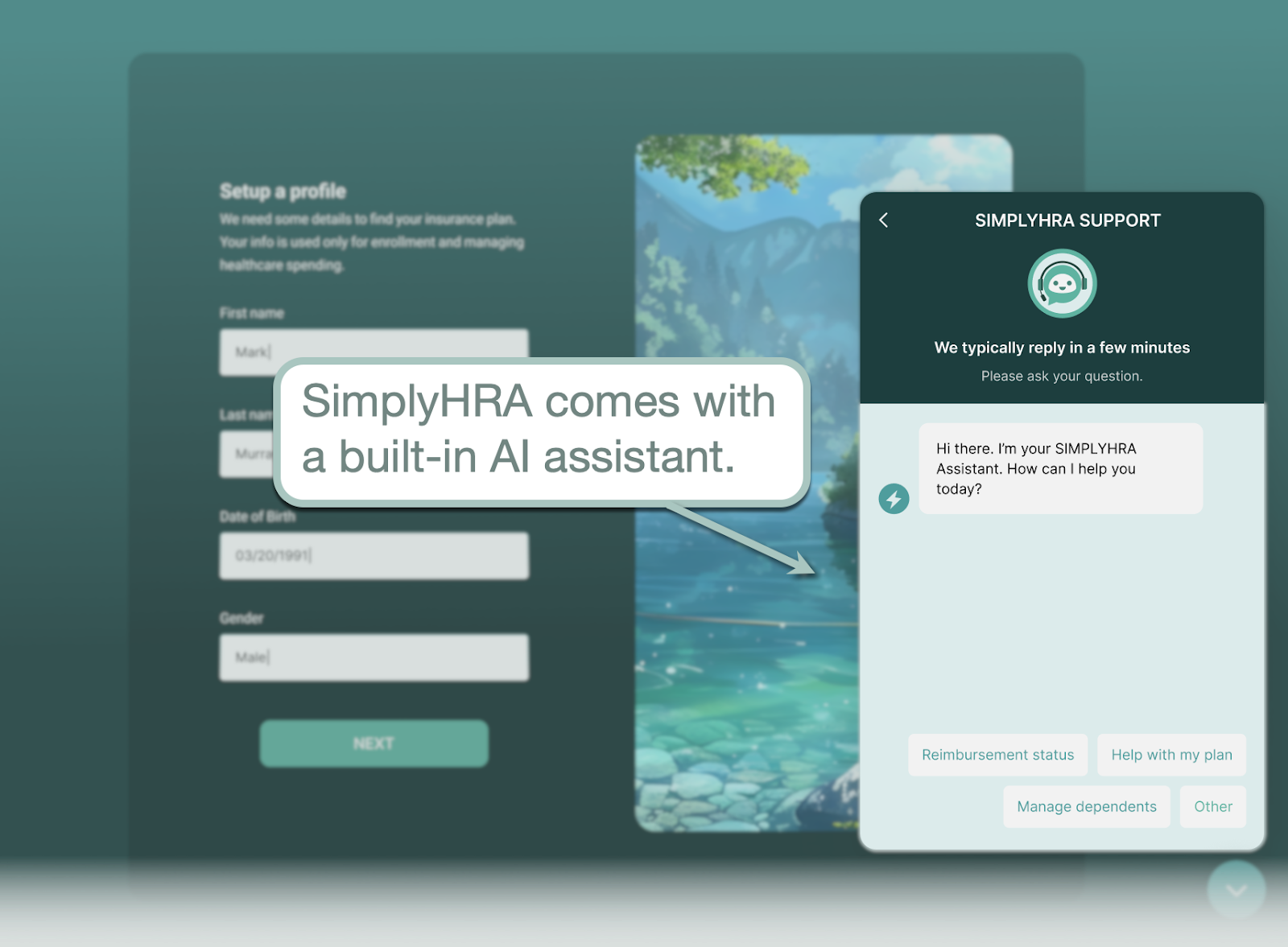
SimplyHRA is a benefits platform specializing in Custom Health Option and Individual Care Expense (CHOICE) Arrangements — streamlining tasks like enrollment, reimbursement management, and reporting through a visual dashboard.
Apart from the AI assistant, SimplyHRA makes it easier for employees to research compatible plans. Right out of the box, it highlights all the key information employees need to make informed decisions.
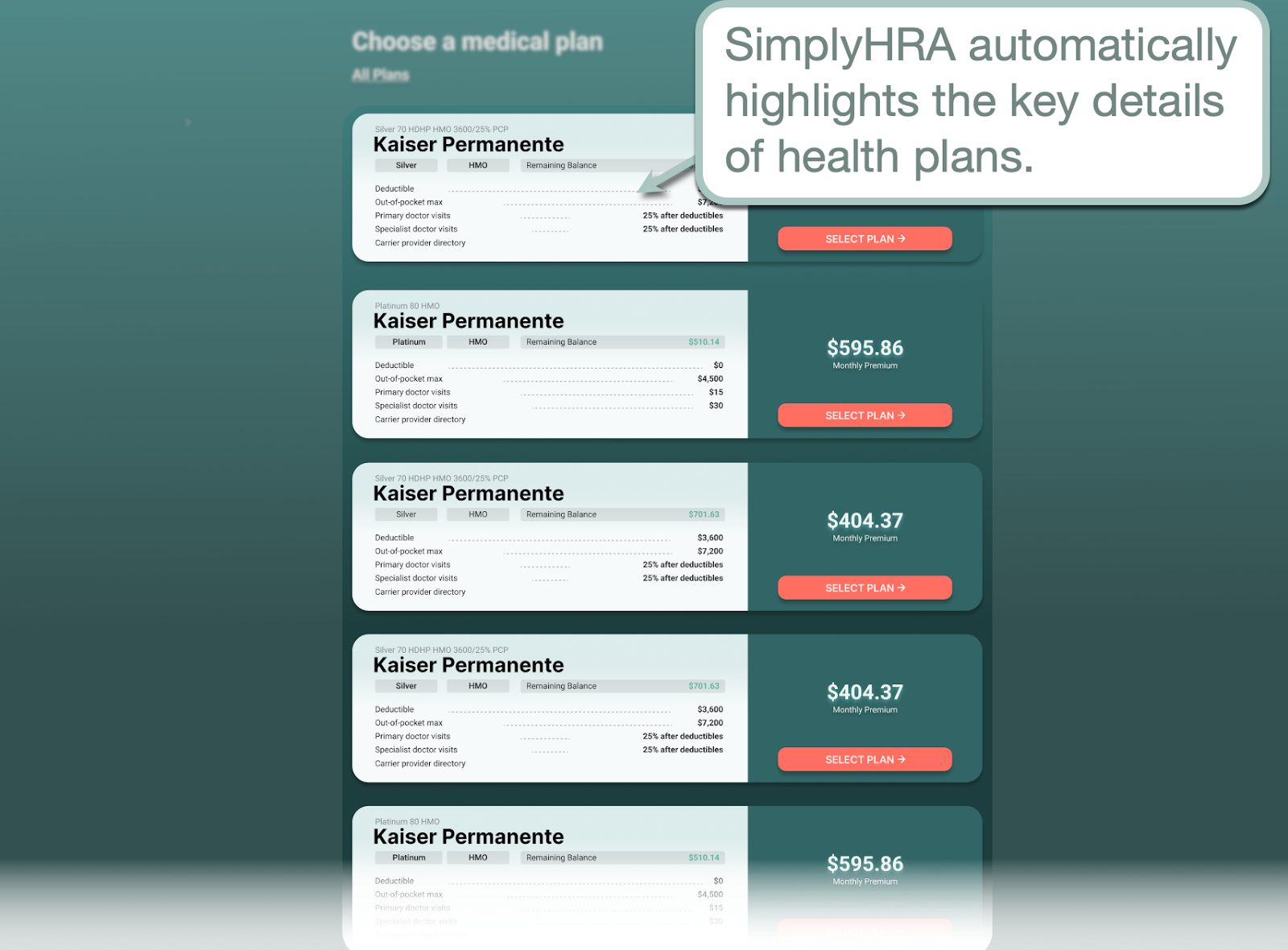
Of course, employees can also ask the SimplyHRA AI Chatbot for plan suggestions based on their health profile.
Tip: Learn more about SimplyHRA's AI assistant and other features by scheduling a personal demo here.
Things to Remember When Using AI to Pick a Health Plan
Despite AI's huge advancements in recent years, remember that it should never be the sole decision-maker for something as important as healthcare.
Practice cross-checking every claim generated by AI, especially if it's a straightforward health plan suggestion. Remember, AI may be highly effective in crunching through a ton of data in near-zero time, but all AI tools are still handicapped by a handful of fundamental limitations:
- Limited access to live data — With a few exceptions (i.e., Grok), most LLMs have no access to live data outside of the fresh SBCs and other resources you attach. That's why you need to double-check details surrounding ever-changing variables, like drug tiers, plan prices, provider directories, and in-network status.
- No foresight — Unless an LLM caught wind of planned changes in the healthcare industry, you need to understand that AI tools can't predict the future. While they can make data-driven forecasts, they aren't built to predict future rate hikes, claims denials, and other events.
- Risk of hallucination — No AI software is immune to the probability of whipping up made-up facts or events. Be extra cautious, especially when the AI tool describes, relies on, or refers to scenarios when generating analogies or recommendations.
Finally, remember that general-purpose AI tools like ChatGPT aren't designed with Health Insurance Portability and Accountability Act (HIPAA) safeguards in mind — unless they're made specifically to be used in healthcare.
That said, never share complete medical records, SSNs, or any other type of sensitive data with any general-purpose AI tool — paid or not. The key exception here is healthcare-specific AI assistants that are trained with HIPAA in mind, like SimplyHRA's AI Chatbot, which doesn't save sensitive information.
Conclusion
For most people, health insurance is a vast and ever-shifting sea of complexity — and AI is the compass that will help you conquer it.
AI demystifies health plans and transforms rows upon rows of data into clean, scannable tables in a snap.
Just remember that, at the end of the day, AI shouldn't make your hard decisions, especially for something as important as healthcare. Software like ChatGPT and Google Gemini are just tools, and they're only as effective as the hands operating them.
Good luck, and if you need help please don't hesitate to contact us!
Related blogs

QSEHRA Plan: 2026 Rules, Limits, Eligibility & Taxes
1094-C vs 1095-C: ACA Employer Reporting Guide 2026