Best Health Insurance for Businesses with Less Than 10 Employees
Under the Affordable Care Act (ACA), the federal 'employer mandate' generally applies only to Applicable Large Employers (ALEs) with an average of 50+ full-time and full-time equivalent employees in the prior year. Employers below that threshold generally aren't required by federal law to offer health coverage.
But you're reading this post anyway, which is awesome.
Remember, employee healthcare is more than just an item in your compliance checklist. It will also help your business compete in the job market, attract the best talent, and keep your workforce in tip-top shape.
The question is, what is the best healthcare plan for small businesses?
How can you be sure that it won't break your bank?
These are just some of the questions we'll answer in this post.
Let's dive right in.
Health Insurance Options for Small Businesses (≤10 Employees)
Here are the employee health insurance options that can offer the flexibility, affordability, and coverage that small businesses need:
1. Individual Coverage Health Reimbursement Arrangement (ICHRA)
ICHRA (Individual Coverage Health Reimbursement Arrangement) is an employer-funded health reimbursement arrangement that reimburses employees for individual health insurance premiums (and, if the employer allows, other eligible medical expenses).
It is hands-down one of the best healthcare options for micro businesses.
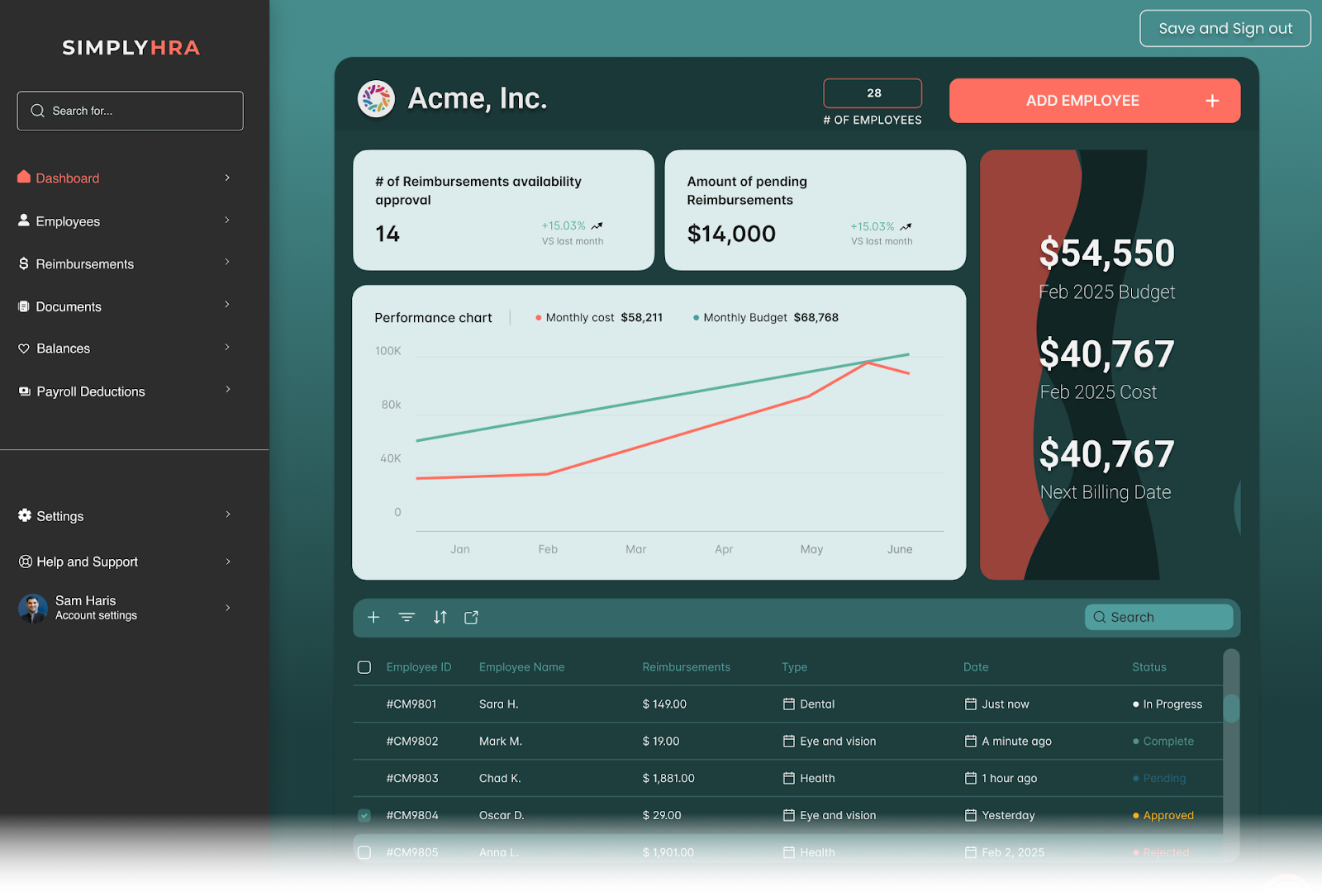
With the help of benefits platforms like SimplyHRA, employers can easily set up their ICHRA plan by defining employee classes, setting monthly reimbursement allowances, managing onboarding, and tracking approvals — all in one dashboard.
Benefits of ICHRA for Small Businesses
- No federal minimum contribution — There's no federal minimum contribution amount for an ICHRA. However, ICHRAs have required administration steps (including required employee notices), and if a business grows into Applicable Large Employer (ALE) status, affordability rules can become important.
- Employee choice — Employees can choose qualifying individual health insurance coverage (on or off the Marketplace) that fits their needs. To receive tax-free reimbursements, employees (and any covered dependents) must be enrolled in qualifying individual health insurance coverage (or Medicare, where permitted); short-term limited-duration insurance and excepted-benefit-only coverage don't qualify. If an employee wants to use Marketplace premium tax credits, they may need to opt out of the ICHRA depending on affordability.
- Tax advantages — Employer reimbursements are generally deductible. Employee reimbursements are generally tax-free only when the ICHRA is properly administered (including required substantiation) and the employee has qualifying individual health insurance coverage (or Medicare, where permitted) for the month.
A great way to learn more about ICHRA is to explore modern, tailor-made benefits platforms like SimplyHRA. Get started by booking a personal demo here.
2. Qualified Small Employer Health Reimbursement Arrangement (QSEHRA)
QSEHRA (Qualified Small Employer Health Reimbursement Arrangement) is a specific type of HRA for eligible small employers that reimburses employees for qualified medical expenses, including individual health insurance premiums, up to an IRS-set annual limit.
In it, employees also get to choose their own health insurance. Employers also retain control over employees' monthly reimbursement allowances.
A key difference is that QSEHRA must be offered on the same terms to eligible employees, though the permitted benefit can vary by age and number of family members (within the IRS annual limits). Furthermore, yearly QSEHRA contributions are capped at limits specified by the IRS.
QSEHRA is generally available only to employers that are not Applicable Large Employers (generally under 50 FTEs) and that do not offer a group health plan to any employees. ICHRA does not have an employer-size cap.
Compliance note: QSEHRAs require a written notice to eligible employees and the permitted benefit generally must be reported on each eligible employee's Form W-2.
Benefits of QSEHRA for Small Businesses
- No Required Minimum Contribution — Although QSEHRA comes with maximum contribution limits, there's no minimum contribution requirement. This guarantees the predictability of your employee healthcare costs, which is huge for small businesses with tight budgets.
- Tax Advantages — QSEHRA also comes packaged with the tax advantages that ICHRA offers. That means monthly contributions are tax-deductible while reimbursements are 100% tax-free.
- Simple Administration — Not only does employee choice relieve some of the administrative burdens of managing healthcare, QSEHRA is also built around uniformity. This makes it easier to set up and manage than other types of CHOICE Arrangement plans.
Learn more about QSEHRA — its features, eligibility requirements, and advantages — by reading this post.
3. SHOP Fully-Insured Small Group Plan
The Small Business Health Options Program (SHOP) is a health insurance marketplace designed specifically for companies with 50 or fewer employees. It offers group health insurance and group dental insurance, which can provide blanket coverage to enrolled, eligible employees.
While traditional group plans may be inaccessible to small businesses, SHOP's fully-insured small group plans are different.
For one, SHOP group health plans are guaranteed-issue. SHOP plans are generally guaranteed-issue for eligible small employers, meaning insurers generally can't deny coverage based on health status. Premium rates are typically set for the plan year, but total premium costs can change with enrollment changes and rates can change at renewal.
Small Business Health Care Tax Credits may be available if you have fewer than 25 FTEs, meet average-wage and employer-contribution requirements, and offer coverage through SHOP. The maximum credit is up to 50% of premiums paid for for-profit employers (up to 35% for eligible tax-exempt employers) and is generally available for two consecutive taxable years.
Benefits of SHOP Fully-Insured Small Group Plans for Small Businesses
- Surefire Coverage Regardless of Employee Health — As guaranteed-issue healthcare, carriers aren't allowed to modify the price of your premiums. In other words, they can't use your company's claims history or your team's current health conditions to jack up your rates.
- Easy enrollment — To enroll in SHOP coverage, you'll typically work with a SHOP-registered agent or broker or enroll through an insurance company (the process can vary by state).
- Predictable Costs — SHOP group health plans offload the risk of covering claims to the carrier. Pricing is also community-rated based on clear-cut factors like age and location.
The main drawback of SHOP plans is the minimum participation requirement: in most states, at least 70% of employees offered coverage must enroll (state rules vary). The minimum participation requirement is waived between November 15 and December 15 each year. Employee choices are also limited to the plans their employer selected for them, unlike CHOICE Arrangements where flexibility is key.
4. Taxable Health Stipends
Remember, you're not legally required to offer health insurance if your employee count is 10 or fewer.
And with a small team, it's sometimes more practical to simply include a fixed dollar amount in each employee's paycheck for healthcare.
Health stipends are typically paid as taxable wages through payroll. To avoid creating an employer-paid premium reimbursement arrangement (which can trigger ACA market-reform compliance issues), stipends are generally paid as unrestricted taxable compensation rather than being conditioned on proof of individual policy premiums or medical expenses.
Benefits of Health Stipends for Small Businesses
- Easy Setup and Administration — Health stipends are a straightforward solution for small businesses looking to keep employees healthy, motivated, and feeling valued. All you have to do is decide on a dollar figure that can adequately and reasonably cover your employees' healthcare needs.
- Predictable and Customizable — Employers have full control over the stipend amount that employees receive for healthcare. They can also easily tailor stipends to match the specific working conditions of each individual employee.
- Employee Flexibility — While employers are in charge of setting stipend amounts, employees ultimately decide how they want to spend it. This can be a net positive for employee satisfaction, depending on the stipend's value and implementation.
While health stipends look great and straightforward on paper, it's not always simple in practice.
For one, employers don't control whether or not employees actually spend their stipend on healthcare. As such, a generous stipend can quickly turn into an expensive lesson in the event of a medical emergency.
Health stipends are taxable wages, so employees will owe income and payroll taxes; the net value depends on the employee's individual tax situation.
Employee Health Insurance Tips for Micro Businesses
Knowing the feasible health insurance options for your small business is just the first step.
You need a strategic roadmap to ensure your employee healthcare strategy is built on solid ground.
Below are five tips to help you achieve this:
- Start with Your Employees — Use a voluntary, anonymous survey focused on benefit preferences (e.g., networks, deductibles, dependent coverage needs) and avoid collecting individualized medical information. Use the results to define selection criteria that fit your team.
- Prioritize Price Predictability — Before you look into plan designs, start defining what your company can afford in the long-term.
- Pick the Right Software — Research benefits platforms and healthcare stipend management systems to make sure you're getting exactly what you need without paying for unnecessary features.
- Reevaluate Your Plan Each Year — Do an annual review of your health benefits strategy to make sure it adapts as your company grows.
- Pay Attention to Administrative Burdens — Factor in the amount of time, work, and money that goes into managing traditional health plans before making the final call.
Implement Your ICHRA Plan with SimplyHRA
Comparing health insurance types side by side, ICHRA has the clear advantage, especially for businesses with 10 or fewer employees.
Predictable healthcare costs? Check.
Employee choice? Check.
Potential tax advantages — When properly administered and paired with qualifying individual coverage, ICHRA reimbursements are generally tax-free to employees.
Easy administration? Absolutely.
The best part is, getting your ICHRA plan up and running is effortless with modern benefits platforms like SimplyHRA. Set your plan allowances and onboard employees, and we'll help administer key steps like eligibility setup, claims substantiation workflows, and required notices—while you remain the plan sponsor responsible for overall compliance.
See whether ICHRA is the right fit for a team under 10 — book a demo to walk through classes, allowances, and the admin workflow.
Related blogs
Checklist for Selecting a Benefits Administrator 2026

How to Structure ICHRA Allowances: 2026 Compliance Rules